
Emily is a co-founder of Burst, writes about moringa nutrition, sourcing and supplement quality, drawing on research into plant-based wellness and everyday nutrition.
Article Summary
The easiest way to use moringa powder is to start with ½ teaspoon (about 1-2g) daily, mixed into a smoothie, water, tea or yogurt, and build up to 1-2 teaspoons (3-7g) as your body adjusts. It has a mild, earthy taste that blends into savory and sweet dishes alike.
What most guides skip: heat does degrade some of moringa's water-soluble vitamins — but not as dramatically as the warnings suggest, since dried powder has already lost most of its vitamin C in processing. Stirring it into hot soup won't "ruin" it; boiling it for 20 minutes will noticeably reduce it.
You've got a bag of moringa powder and a vague sense it's good for you. Now what? This is genuinely one of the most common questions people have after buying moringa for the first time, and most guides answer it with a thin list of "sprinkle it on things" and call it done. Here's a proper answer: 12 specific ways to use moringa powder every day, the right amount per serving, and the mistakes worth avoiding.
How Much Moringa Powder Should You Use Per Serving?
Start lower than you think, then build up. Moringa is nutrient-dense enough that overdoing it early on can cause mild digestive discomfort — not dangerous, just unnecessary.
| Stage | Amount | Notes |
|---|---|---|
| First week | ½ tsp (1-2g), once daily | Let your digestive system adjust |
| Ongoing daily use | 1-2 tsp (3-7g), once or split into two | Most people settle here long-term |
| Maximum sensible daily intake | Around 1 tbsp (10-15g) | More isn't better — see our full moringa dosage guide |
Once you've settled on a serving size, the format matters less than consistency — see our guide on what actually happens when you take moringa every day for what to expect on that timeline.
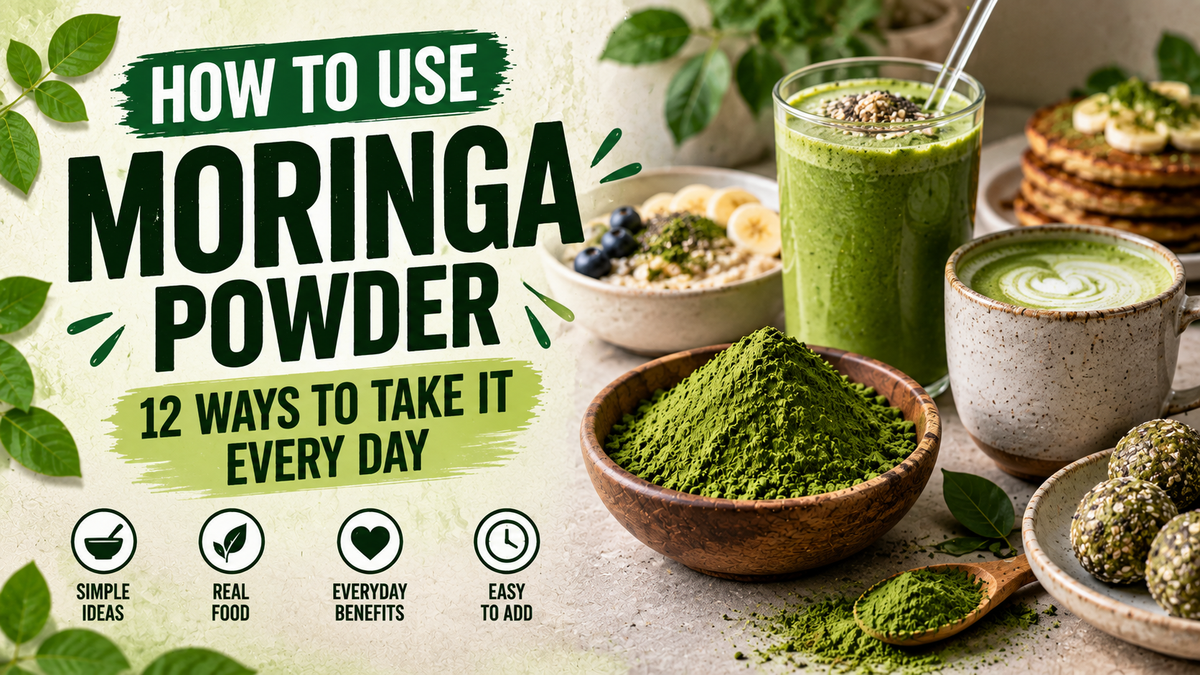
12 Ways to Use Moringa Powder
- Blended into a smoothie — the easiest, most forgiving way to start
- Stirred into moringa water — just powder, water and a squeeze of lemon
- Brewed as a warm moringa tea — steeped or stirred into hot water
- Mixed into yogurt — plain or Greek, with honey to balance the earthiness
- Stirred into oats or overnight oats — add after cooking, not during
- Added to soup — stirred in at the end of cooking, off the heat
- Baked into muffins or energy balls — a small, forgiving dose per serving
- Whisked into salad dressing — pairs well with lemon, olive oil and garlic
- Sprinkled over avocado toast or eggs — like a green seasoning
- Blended into pesto or sauces — adds color and a mild vegetal note
- Mixed into juice — apple or orange juice masks the taste well
- Stirred into a warm "golden milk" style drink — with plant milk and a pinch of turmeric or cinnamon
The next few sections go deeper on the four most popular methods — smoothies, tea/moringa water, yogurt-oats-soup, and baking — since that's where most people actually build a lasting habit.
In a Smoothie (the Easiest Way)
If you only try one method, make it this one. Moringa's earthy taste disappears almost entirely against banana, berries, mango or a bit of nut butter.
A simple starting formula: 1 banana, a handful of frozen berries, 1 cup milk or plant milk, ½-1 tsp moringa powder, blended until smooth. Add the powder last so it doesn't clump at the bottom of the blender.
This is also the format most people default to when introducing moringa to kids, since sweeter fruit bases mask the taste completely.
As a Hot or Cold Moringa Tea
"Moringa water" and "moringa tea" both describe the same basic idea: dissolving the powder directly in water rather than food. It's the simplest possible way to take it, with nothing to mask the taste — so it works best once you're already used to the flavor.
- Hot: stir ½ tsp into a mug of hot (not boiling) water, add lemon and honey if you like
- Cold: shake or blend ½ tsp into a glass of cold water — a squeeze of lemon or a splash of apple juice helps a lot
Because this method has nothing else to dilute the taste, it's usually the one people either love immediately or find they need to work up to — see the taste-fix section below if that's you.
Stirred Into Yoghurt, Oats or Soup
These three share the same principle: moringa blends into anything with enough body and its own flavor to carry it.
- Yoghurt: stir ½-1 tsp into plain or Greek yoghurt with a drizzle of honey — the tang and sweetness balance moringa's earthiness well
- Oats: stir in after cooking, not while the oats are still on the heat, to limit unnecessary nutrient loss (more on this below)
- Soup: stir into vegetable or chicken soup right at the end of cooking, off the heat, for the same reason
This is also how moringa is traditionally used in many cultures — cooked into soups and porridges — so there's nothing unusual about it; the timing (added at the end rather than simmered for an hour) is the only real refinement worth making.
In Baking and Energy Balls
Moringa holds up reasonably well in baking, since most home baking temperatures and times are shorter and gentler than industrial processing. Stir it into muffin, pancake or energy-ball mixtures at roughly ½-1 tsp per batch (adjust to taste — it's easy to add more, harder to fix an overpowering batch).
Simple energy ball formula: dates, oats, nut butter, a pinch of salt, and ½-1 tsp moringa powder, blended and rolled — no baking required, so nothing is lost to heat at all.
What Not to Do: Heat, Coffee and Dosage Mistakes
A few genuine mistakes worth avoiding — and one common warning that's more nuanced than it sounds.
Heat, honestly explained: moringa does contain heat-sensitive nutrients, mainly vitamin C and some B vitamins, and research on prolonged high heat has found losses of 40-50% in these water-soluble vitamins. But dried moringa powder has already lost most of its vitamin C during drying and processing — it's a relatively small number to begin with. Stirring moringa into a hot soup or tea for a few minutes is not the same as boiling it for 20 minutes; the former is a minor, unavoidable tradeoff, the latter is where you actually lose a meaningful amount. If it matters to you, stir moringa in off the heat or after cooking rather than during — that's the one adjustment actually worth making.
Coffee: there's no established harmful interaction between moringa and coffee, but mixing them in the same cup tends to be an unpleasant flavor clash rather than a genuine problem — most people prefer to keep them separate, in different parts of the routine.
Dosage mistakes: the most common mistake isn't taking too much — it's starting at 1-2 tsp on day one instead of building up, which is what causes the mild digestive discomfort some first-time users report. The fix is simple: start at ½ tsp for the first week, regardless of how motivated you feel.
Related: Moringa Powder vs Capsules
If taste or prep is the real obstacle rather than the routine itself, capsules deliver the same leaf with none of the mixing.
Read the full guide →How to Use Moringa Powder If You Hate the Taste
Moringa's taste is mild and earthy, closer to matcha or spinach than anything genuinely unpleasant — see our comparison of moringa vs matcha if that's a useful reference point. But if you're struggling with it, a few things reliably help:
- Pair it with something sweet and strong-flavored: banana, mango, berries, honey or apple juice all mask it effectively
- Start smaller than the recommended dose: ¼ tsp is easier to get used to than diving straight into a full teaspoon
- Avoid moringa water/tea first: that's the format with nothing to hide the taste — build up your tolerance in smoothies or yoghurt before trying it straight
- Switch to capsules: if the taste genuinely isn't for you after a fair attempt, capsules deliver the identical leaf with zero flavor — see our powder vs capsules comparison
Do You Need to Take It With Food?
Not strictly — moringa isn't like certain fat-soluble supplements that require food for absorption. But there's a genuinely good practical reason to take it with a meal anyway: it's gentler on digestion, particularly while your body is still adjusting in the first week or two, and it's simply easier to remember consistently when it's attached to something you already do daily, like breakfast.
If you do want to optimize absorption specifically, pairing moringa with a source of vitamin C — citrus, berries, or a splash of orange juice — can help with iron absorption, one of moringa's more notable nutrients.
However you build the habit — smoothie, tea, yoghurt or capsules — the method that actually works is the one you'll still be doing in three months. Moringa's benefits build with consistent daily use, not any single "correct" way of taking it, so pick whichever of the twelve above fits your existing routine rather than the one that sounds most impressive.
How to Use Moringa Powder: Frequently Asked Questions
How do I use moringa powder every day?
Start with ½ teaspoon mixed into a smoothie, yoghurt or water once daily, and build up to 1-2 teaspoons as your body adjusts. Consistency matters more than the specific method — pick whichever fits your existing routine.
How do you drink moringa powder?
Stir ½-1 teaspoon into water, tea or juice. Because there's nothing else to mask the taste, this is often easier once you're already used to moringa from smoothies or yoghurt first.
Can you put moringa powder in hot drinks or cooking?
Yes. Heat does reduce some heat-sensitive vitamins, but the effect is modest for normal cooking and brewing — it becomes meaningful mainly with prolonged high heat, like boiling for 20+ minutes. Stirring it in off the heat or at the end of cooking limits any loss.
What's the best time of day to take moringa powder?
There's no single best time — morning is common since it fits naturally into breakfast smoothies or coffee-free routines, but consistency matters far more than the specific hour.
Can you mix moringa powder with coffee?
There's no known harmful interaction, but the flavors don't combine well for most people. Most prefer to keep them as separate parts of the day rather than mixing them in one cup.
Pure Powder, Any Way You Take It
Wild-harvested, single-origin moringa — grown in nutrient-rich Southern African soil, free from fillers, and processed for smoother mixing.