
Emily is a co-founder of Burst, writes about moringa nutrition, sourcing and supplement quality, drawing on research into plant-based wellness and everyday nutrition.
Article Summary
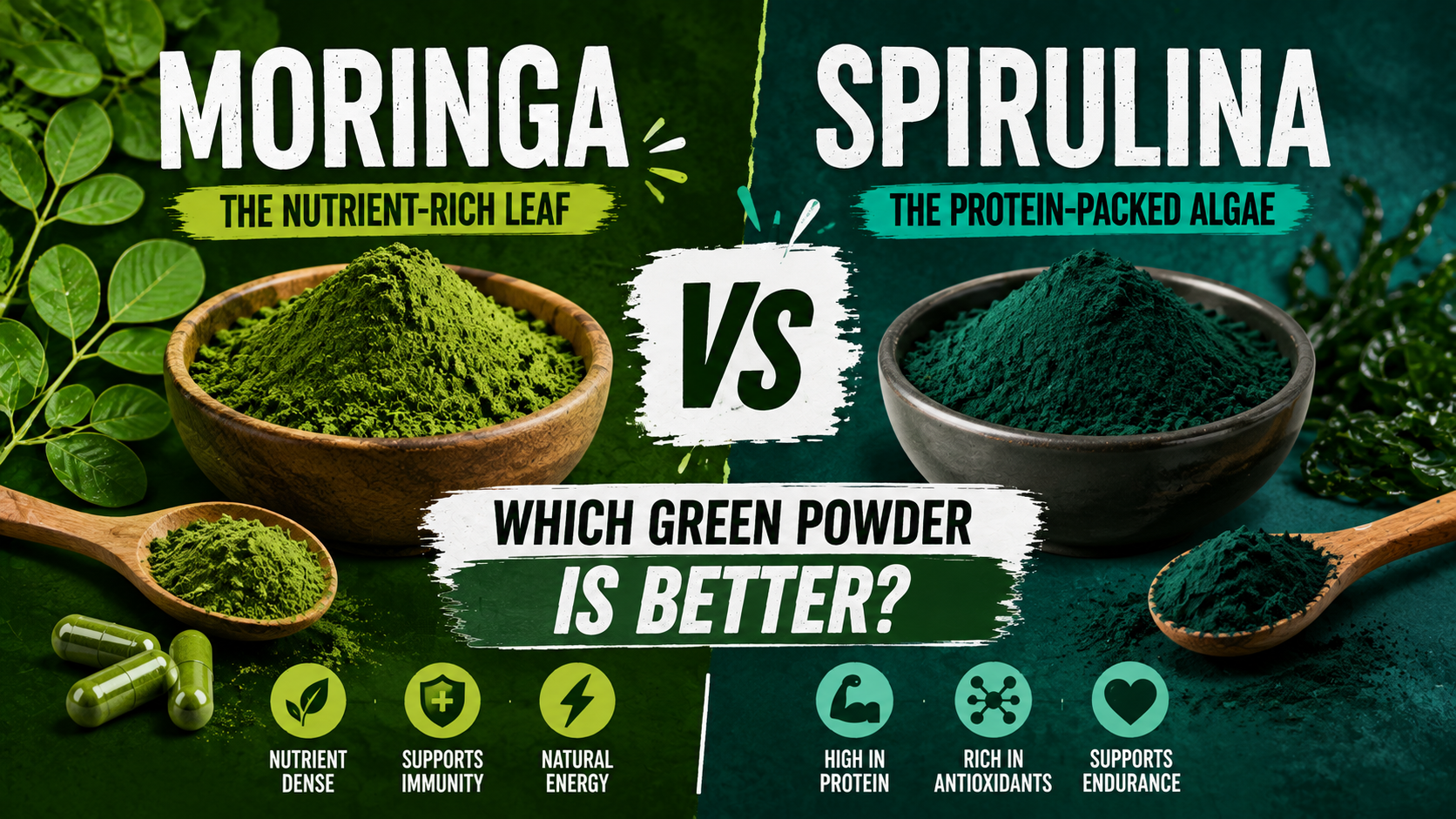
Moringa and spirulina are both green powders, but they do different jobs. Spirulina is an algae and a protein specialist — around 57–60% protein by weight, plus phycocyanin, an antioxidant nothing else has. Moringa is a tree leaf and a generalist: about half the protein, but far more calcium, beta-carotene and dietary fibre, plus plant compounds spirulina has no equivalent of. Spirulina wins protein. Moringa wins breadth, fibre and taste.
Two things most comparisons get wrong: spirulina is not a usable source of vitamin B12 — it contains a pseudo-form the body can't absorb, which matters enormously if you're vegan — and moringa does not have dramatically more iron than spirulina. They're roughly equal per gram, whatever the marketing says. Many people take both. Almost nobody needs to choose.
Moringa and spirulina are both green powders, but they are not the same kind of thing. One is a leaf from a tree. The other is an algae grown in water.
Spirulina is best when you want concentrated plant protein. Moringa is better when you want broad, whole-leaf daily nutrition.
That is the simplest answer.
Spirulina is roughly 57–60% protein by weight, which is remarkable, and it contains phycocyanin — an antioxidant pigment nothing else in your cupboard has. Moringa comes from the leaves of the Moringa oleifera tree. It has less protein per gram, but a much wider spread of vitamins, minerals, fibre and plant compounds.
So the better choice depends on what job you want the powder to do.
One more thing before we start, because it matters more than anything else in this comparison: most articles about spirulina will tell you it is a good source of vitamin B12. That is not correct, and if you are vegan it is worth understanding why. We cover it below.

Quick answer: should you choose moringa or spirulina?
Choose this if you want
Moringa
- ✓Broad daily nutrition rather than one concentrated nutrient
- ✓Calcium, beta-carotene and dietary fibre
- ✓A green powder that's genuinely easy to drink
- ✓Isothiocyanates, quercetin and kaempferol
- ✓Something you'll still be taking in six months
Choose this if you want
Spirulina
- ✓The highest plant protein per gram you can get
- ✓Phycocyanin, its signature antioxidant
- ✓A targeted supplement to hit protein goals
- ✓GLA, an anti-inflammatory omega-6 fatty acid
- ✓Something to take around training
For most people looking for a daily wellness foundation rather than a protein supplement, moringa is the more practical everyday choice. For anyone chasing grams of protein, spirulina wins and it isn't close.
What is spirulina?
Spirulina is a blue-green algae — technically a cyanobacterium — that grows in warm, alkaline water. It was harvested by the Aztecs from lakes around modern-day Mexico City, and it is grown commercially today in ponds and closed tanks.
It is famous for two things. The first is protein density: dried spirulina is around 57–60% protein by weight, which is higher than almost any other whole food. The second is phycocyanin, the blue pigment that gives spirulina its colour and acts as a potent antioxidant.
Spirulina is known for:
- very high protein per gram
- all nine essential amino acids
- phycocyanin
- gamma-linolenic acid (GLA)
- B vitamins and copper
- a strong, distinctly aquatic taste
What is moringa?
Moringa is a nutrient-dense leaf from the Moringa oleifera tree, sometimes called the drumstick tree or the miracle tree. It grows across India, Africa and other tropical regions, and it has been used as food and medicine for generations.
Moringa is not an algae. It is a leafy green — closer in spirit to spinach or kale than to spirulina, just far more concentrated.
Moringa is commonly used to support:
- daily energy and vitality
- immune health
- general nutrition
- blood sugar balance
- digestion and gut health
- long-term resilience
Moringa vs spirulina: the main difference
The biggest difference is this:
Spirulina gives you depth. Moringa gives you breadth.
Spirulina is exceptional at a small number of things. Protein, phycocyanin, GLA. Outside those, it thins out quickly — it has almost no fibre, very little calcium, and modest vitamin C.
Moringa is good at a lot of things at once. It has less protein, but more calcium, more beta-carotene, real dietary fibre, and a wider set of plant compounds. It behaves like a concentrated vegetable rather than a targeted supplement.
That is why they feel different in a routine. Spirulina is a tool. Moringa is a foundation.
Moringa vs spirulina comparison table
Figures below are per 10g of powder, which is the standard used across the research. Note that a typical moringa serving is smaller than that — a Moringa Burst scoop is 5g, so halve the moringa column for a real-world serving.
| Per 10g | Moringa | Spirulina |
|---|---|---|
| Source | Leaf of the moringa tree | Blue-green algae |
| Protein | ~2.5–2.9g | ~5.7g |
| Essential amino acids | All nine | All nine |
| Calcium | ~150–200mg | ~12mg |
| Iron | ~2.1–2.8mg | ~2.9mg |
| Dietary fibre | ~1.5–3g | ~0.4g |
| Sodium | ~2–3mg | ~105mg |
| Potassium | ~135mg | ~136mg |
| Vitamin C | ~2mg | ~1mg |
| Beta-carotene | High | Low |
| Vitamin B12 | None | Pseudo-B12 — not usable by humans |
| Copper | Modest | ~0.6mg (~68% DV) |
| Signature compounds | Isothiocyanates, quercetin, kaempferol, chlorogenic acid | Phycocyanin, GLA, superoxide dismutase |
| Taste | Earthy, green, like mild spinach | Strong, marine, slightly metallic |
| Best for | Broad daily nutrition | Concentrated protein |
| Main caution | Ask a professional if pregnant, medicated or managing a condition | Contamination risk if untested; avoid with autoimmune conditions or PKU without advice |
Figures reconciled against USDA data and published composition studies. Both powders vary with growing conditions and processing, hence the ranges. A Moringa Burst scoop is 5g — halve the moringa column for a real-world serving.
Protein: where spirulina wins
This is not a close contest and we are not going to pretend it is.
Spirulina is roughly twice as protein-dense as moringa, gram for gram. If your goal is hitting a protein target on a plant-based diet, spirulina does that job better than moringa does.
Both are complete proteins — both contain all nine essential amino acids. But 10g of spirulina gives you around 5.7g of protein, where 10g of moringa gives you around 2.7g.
Worth keeping in perspective, though: 5.7g of protein is about one egg. Neither powder is a protein shake. If you need 30g of protein after training, spirulina is not the efficient way to get it — you would be eating 50g of algae. Spirulina is best understood as a nutrient-dense protein food, not a protein supplement.
The vitamin B12 problem
This is the most important section in this article, and most comparisons get it wrong.
Spirulina does contain something that looks like vitamin B12 on a lab test. But the overwhelming majority of it is pseudo-vitamin B12 — a chemical analogue called cobamide. It has a similar structure to real B12, but the human body cannot use it.
Worse, the analogues appear to compete with real B12 for absorption. So spirulina is not simply a poor B12 source. For someone already at risk, it may make a marginal B12 status worse while a label reassures them they are covered.
This matters because vegans are exactly the group most likely to reach for spirulina, and exactly the group most at risk of B12 deficiency — which causes fatigue, nerve damage and lasting neurological harm if left unaddressed. B12 deficiency is often silent until it isn't.
If you are plant-based, get your B12 from a fortified food or a proper cyanocobalamin or methylcobalamin supplement. Not from algae. Not from moringa either — moringa contains no B12 at all, and we are not going to claim otherwise.
(Researchers have recently grown spirulina under controlled light conditions that does produce active B12. That is genuinely interesting science, but it is not what is in the tub on the shelf.)
Iron: the claim both sides get wrong
Moringa marketing loves iron. So does ours, historically. It deserves a correction.
Published composition studies put dried moringa leaf powder at roughly 21–28mg of iron per 100g. USDA data puts dried spirulina at 28.5mg per 100g. Per gram, they are essentially the same.
You will find moringa articles claiming five or six times that figure. One of the sources we reviewed for this piece prints an iron number in its table that contradicts, by a factor of five, the scientific paper it cites two paragraphs later.
Moringa does have one real advantage here: it contains more vitamin C than spirulina, and vitamin C improves absorption of non-heme iron. But that is a modest edge, not the knockout the marketing suggests. If you are treating an iron deficiency, talk to a doctor — neither powder is the answer on its own.
Fibre: where moringa wins
Spirulina has almost no dietary fibre. Around 0.4g per 10g serving. This is not a flaw — it is an algae, it was never going to.
Moringa, being a leaf, brings real fibre. That feeds gut bacteria, slows glucose absorption and supports regular digestion. Most people in the UK and US eat around 16g of fibre a day against a 30g target, so this is a gap worth filling.
It is also part of why moringa is associated with blood sugar balance. The fibre slows things down; the isothiocyanates appear to do the rest.
Antioxidants: different tools, not better tools
Both are antioxidant-rich. They just work differently.
Spirulina's headline compound is phycocyanin, which is genuinely unique — no plant produces it. It is particularly effective against lipid peroxidation, and it is being studied for endurance and inflammation.
Moringa brings flavonoids and polyphenols instead: quercetin, kaempferol, chlorogenic acid, plus isothiocyanates that spirulina has no equivalent of.
You will see articles score this round with ORAC values — usually something like "moringa 53,000 versus spirulina 24,000." Treat those numbers with caution. The USDA withdrew its ORAC database in 2012 because the scores did not reliably predict anything that happens in a human body. A high ORAC value in a test tube is not the same as an antioxidant effect in you.
The honest read: both deliver real antioxidant support through different chemistry. Neither destroys the other.
Taste and daily use
This matters more than people think. A powder only works if you actually take it.
Spirulina taste. Spirulina tastes like the water it grew in — sharp, marine, faintly metallic. Some people genuinely don't mind it. Many find it hard to mask without burying it in fruit and sweetener, which changes what you're drinking. Consistency is where most spirulina routines quietly die.
Moringa taste. Moringa tastes green and earthy, closer to matcha or mild spinach. It isn't candy, but you can drink it in water without wincing. It also behaves like a leafy green in cooking — it goes into soups, dals and sauces where spirulina would be strange.
This is where BURST™ Moringa Powder has a practical advantage. It is designed for smoother mixing than standard moringa powders, which are often gritty and sink to the bottom of the glass. Better mixing means better daily consistency, and consistency is the whole game.
Purity: the part nobody enjoys writing about
Spirulina grown in open, uncontrolled water can pick up microcystins — liver toxins produced by other blue-green algae that share the same environment — as well as heavy metals. This is a documented, well-understood risk, and it is precisely why reputable spirulina brands test every batch and publish results.
Moringa has a parallel issue. It is grown in soil, and soil can carry heavy metals, which the plant will take up. Same principle, different medium.
So the rule is identical for both: buy from someone who tests and shows you the results. With either powder, an untested product from an unnamed source is a gamble, and the price difference is never worth it. Our own testing is published for exactly this reason.
Is moringa a good spirulina alternative?
Yes — but only if you want the right thing.
Moringa is not a spirulina substitute. It has roughly half the protein and none of the phycocyanin. If you bought spirulina specifically for protein, moringa will disappoint you.
But moringa is an excellent alternative if you want:
- a broader daily nutrient profile
- dietary fibre
- calcium and beta-carotene
- a green powder you can actually drink
- something that works in food as well as smoothies
And if you bought spirulina for the B12, moringa is not the alternative either. A B12 supplement is.
Can you take moringa and spirulina together?
Yes, and this is what a lot of people sensibly do.
They don't overlap much. Spirulina brings protein and phycocyanin. Moringa brings fibre, calcium, beta-carotene and isothiocyanates. Taking both covers more ground than either alone.
A practical approach:
- Spirulina when you want protein density or are training
- Moringa as your daily nutritional baseline
You can put both in the same smoothie. Be warned that the colour is unappealing and the spirulina will dominate the taste.
If you are pregnant, breastfeeding, taking medication, or managing a health condition, talk to a healthcare professional first. Spirulina in particular is generally avoided by people with autoimmune conditions or phenylketonuria (PKU).
Where Burst Moringa powder fits
Our moringa powder is the natural comparison to spirulina powder, because both are daily green powders you scoop and mix.
The difference is what the powder is for.
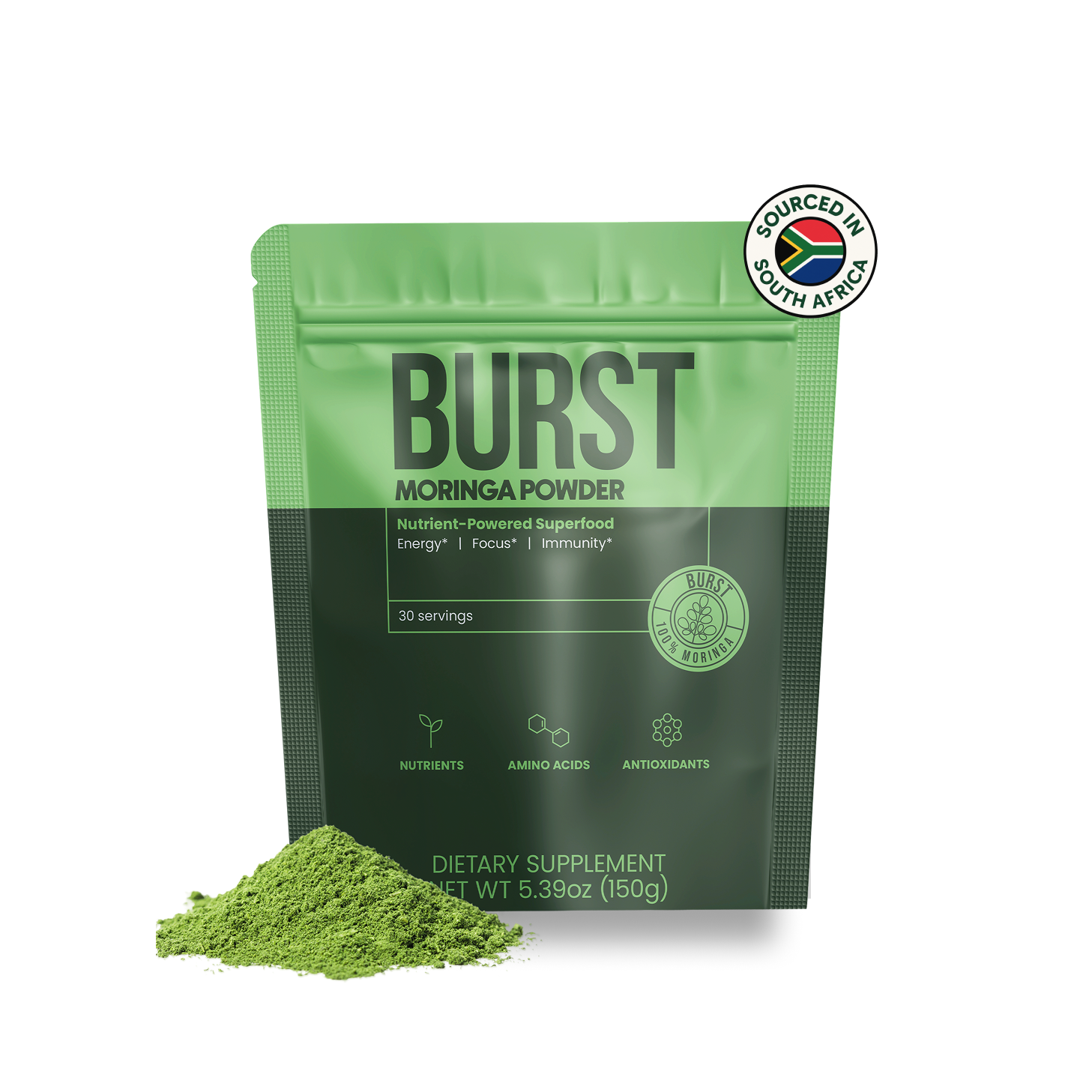
Spirulina is a targeted tool. Burst is a daily foundation — a measured 5g scoop of single-origin moringa leaf from one family farm in South Africa, processed to keep more of the nutrition accessible and to mix without grit.
Burst helps reduce nutrient loss from intact plant cell walls, supports better nutrient accessibility, and gives the powder a smoother mixing experience than standard moringa powder. That matters because a green powder only works in real life if you can use it consistently. The product truth is not nutrients on paper. It is usable nutrition, a practical dose, and daily consistency.
When capsules are the better choice
Powder is the natural comparison to spirulina, but capsules still have a place.
Choose Moringa Capsules if you want the benefits of moringa but not:
- the taste
- the mixing
- the prep
- the green drink routine
Capsules are the easiest starting point. Pre-measured, portable, simple. For busy people and frequent travellers, that matters more than the small cost premium.
Our powder vs capsules guide covers the trade-off properly.
Which is better for muscle and training?
Spirulina, for protein. Its phycocyanin content is also being studied for endurance, which is a reasonable reason to take it around training.
But keep the scale honest. A 10g serving gives you about one egg's worth of protein. If you are building muscle, spirulina is a useful addition to a diet that already hits your protein target — not the thing that gets you there.
Which is better for weight loss?
Neither should be sold to you as a weight-loss solution, and we won't.
Spirulina has some early research on body fat and waist circumference, though the studies are small. Moringa's fibre may support satiety and steadier blood sugar, which can help a healthier routine hold together.
But no green powder replaces food quality, sleep, movement, protein intake and calorie balance. Our honest take on moringa and weight loss goes further.
Which is better for daily wellness?
For daily wellness, moringa wins.
Not because spirulina is weak — it isn't. But spirulina is a specialist. It is superb at protein and phycocyanin and comparatively thin everywhere else, it tastes like a harbour, and its most-marketed benefit (B12) doesn't hold up.
Moringa covers more ground, brings fibre that spirulina structurally cannot, and is pleasant enough to take every day for years. For a green powder that supports energy, immune health, nutrition and general wellness, moringa is the more complete daily option.
Practical guide: how to choose
Choose spirulina if your main goal is:
- maximum plant protein per gram
- phycocyanin and GLA
- support around training
Choose moringa powder if your main goal is:
- broad daily nutrition
- fibre, calcium and beta-carotene
- smoothies, oats or food-based routines
- a green powder you'll stick with
Choose moringa capsules if your main goal is:
- no taste
- no prep
- no mixing
- the easiest possible consistency
Moringa vs spirulina is not really a battle between two green powders. It is a choice between two different jobs. Spirulina is a concentrated protein food with a unique antioxidant and a marine taste, best used deliberately. Moringa is a nutrient-dense leaf that works as a daily foundation — broader, gentler, easier to live with. Many people use both. Almost nobody needs to pick a side. If spirulina isn't the algae you're weighing moringa against, our guide to moringa vs chlorella covers the other popular comparison.
FAQs: Moringa versus Spirulina
Is moringa better than spirulina?
It depends on your goal. Moringa is better for broad daily nutrition, fibre, calcium and beta-carotene. Spirulina is better for concentrated protein and phycocyanin. Neither is universally better — they do different jobs.
Does spirulina really have vitamin B12?
Not in a form you can use. Most of the B12 in spirulina is pseudo-vitamin B12, a chemical analogue the human body cannot absorb, and it may compete with real B12 for absorption. If you are vegan or vegetarian, get B12 from a fortified food or a proper supplement — not from spirulina.
Which has more protein, moringa or spirulina?
Spirulina, by roughly double. Dried spirulina is around 57–60% protein by weight; moringa leaf powder is around 25–30%. Both are complete proteins containing all nine essential amino acids.
Which has more iron, moringa or spirulina?
They are roughly equal per gram — around 21–28mg per 100g for moringa leaf powder and about 28.5mg per 100g for dried spirulina. Claims that moringa has several times more iron than spirulina do not hold up against published composition data. Moringa does contain more vitamin C, which helps with iron absorption.
Can I take moringa and spirulina together?
Yes. They overlap very little, so taking both covers more nutritional ground than either alone. Many people use spirulina for protein and moringa as a daily baseline. Check with a healthcare professional if you're pregnant, breastfeeding, on medication or managing a condition.
Which tastes better, moringa or spirulina?
Moringa, for most people. Moringa tastes earthy and green, similar to mild spinach or matcha. Spirulina has a strong marine, slightly metallic flavour that many find difficult to mask. Since consistency matters more than any single nutrient, taste is a more important factor than it looks.
Is spirulina safe?
Generally yes, from a tested source. The main concern is contamination — spirulina grown in open, uncontrolled water can carry microcystins or heavy metals, so buy from a brand that tests every batch and publishes results. Spirulina is usually avoided by people with autoimmune conditions or phenylketonuria (PKU) without medical advice.
Is moringa powder good in smoothies?
Yes. Moringa blends well into smoothies, oats and yoghurt. Grind quality and processing affect how easily it mixes — finer, well-processed powder blends more smoothly than coarser alternatives.
A Green Powder You'll Actually Drink
Single-origin moringa from one family farm in South Africa. A measured 5g scoop, no grit, no fillers, and third-party test results published before you buy.
Shop Moringa Powder →Disclaimer: This article is produced by Moringa Burst, and we make moringa — read it with that in mind. Nutritional figures are reconciled against USDA data and published composition studies as of July 2026; the nutrient content of both powders varies with growing conditions, processing and source, which is why we've given ranges. Moringa and spirulina are dietary supplements and are not intended to diagnose, treat, cure or prevent any disease. Individual results may vary. If you are pregnant, breastfeeding, taking medication or managing a health condition — and particularly if you are relying on any supplement for vitamin B12 — speak to a healthcare professional.